You might think that a book on joy is going to tell you things aren’t as bad as they seem. If it did, you would rightly set it aside, because while we all wish that were true, if you are reading this book it is probably safe to say your experience suggests otherwise.
Things are not only as bad as you have experienced, they are far worse. That is the bad news. The good news is that God has tools that are capable of enabling you to feel greater joy than you ever have in spite of what you know, and that these tools are also sufficient to overcome all the bad of which you are not yet aware.
This world is a dark place. In fact, it is almost surely darker than you yet know.
How bad is it? We all have a physical limit of pain, the point at which we would die because it is so great. We seem to be able to endure more mental pain than physical pain, but there, too, exists an absolute limit.
This world is a bad enough place that if you were to experience the depths of what can happen here without the appropriate tools, you would immediately die.
Fortunately, good exists in equal quantities to bad. The tools God provides are capable of minimizing the duration and effects of the negatives while maximizing the duration and effects of the positives. Those who obtain and use the tools that are available to maximize joy will eventually see the reasons for what they’ve gone through, the promised result, and that there was no other way.
5 They that sow in tears shall reap in joy.
6 He that goeth forth and weepeth, bearing precious seed, shall doubtless come again with rejoicing, bringing his sheaves with him. (Psalm 126)
Their torment will turn to joy, their sorrows will flee away, and all that will remain is the joy they’ve obtained.
Hope drives you forward
In this life, you perceive only the suffering that is directly before you and not the blessings that are yet unseen.
Why keep moving forward deeper into the darkness when the light always comes slower than the darkness and in ways that seem fleeting and insufficient to make it worthwhile? Hope provides the answer.
But what are you to hope for? Paul said:
...Eye hath not seen, nor ear heard, neither have entered into the heart of man, the things which God hath prepared for them that love him. (1 Corinthians 2:9)
How can you hope for what you have not yet seen, heard, or thought about? How can you hope for what you can’t even imagine?
An understanding of the law of equal and opposite is the key to having the tenacity of hope required to obtain great joy in life. The Lord explained this principle when he explained the outcome of those who have lost everything for his sake:
27 Then answered Peter and said unto him, Behold, we have forsaken all, and followed thee; what shall we have therefore?
29 And every one that hath forsaken houses, or brethren, or sisters, or father, or mother, or wife, or children, or lands, for my name's sake, shall receive an hundredfold, and shall inherit everlasting life. (Matthew 19)
For every possible suffering in life there exists an outcome much greater than the price. If you believe Jesus, you can have peace so immense that you can be free from fear and anxiety, in spite of anything the world can do to you.
Hope in God is always possible, no matter how dark your situation may be. The Lord is the light, “And the light shineth in darkness; and the darkness comprehended it not.” (John 1:5) The light shines in all things and through all things, even if all things are not aware of it.
This description is not figurative. You may feel like you are drowning in darkness, but in reality you are always surrounded by incomprehensible amounts of light.
You can find immense joy in anything, anyone, and any situation if you trust God enough to endure the specific set of lessons required to unlock your ability to perceive and comprehend the light and darkness in it.
When we are surrounded by darkness, we ought to hope for equal and opposite joy. We ought to realize that, although the full details of how it will happen and of what it consists lie outside our present understanding, we will indeed encounter joy that surpasses all the pain and suffering we have experienced.
Not only is God just, he is not arbitrary. Everything you endure is limited to exactly what is necessary in order for you to gain the equal and opposite. “But behold, all things have been done in the wisdom of him who knoweth all things.” (2 Nephi 2:24)
God ensures that “...all things wherewith you have been afflicted shall work together for your good, and to my name’s glory...” (D&C 98:3)
These are not trivial concepts. They are powerful, and embracing them will strengthen you against any trial in life and beyond.
For instance, Stephen had enough peace while being stoned to death that he prayed for his assailants. Isaiah was able to be sawn in half without doubting his mission and purpose.
The Lord himself was focused enough to arrange for the care of his mother, address the needs of a man crucified with him, and pray for the soldiers who nailed him to the cross, all while suffering maximal physical and unimaginable spiritual affliction on the cross.
But for a moment
Tough times abound, and while you are in them, they are allencompassing. In order to overcome these tough times, it becomes necessary to realize and trust in the fact that tough times never last forever and always yield results that are worth the pain:
For our light affliction, which is but for a moment, worketh for us a far more exceeding and eternal weight of glory; (2 Corinthians 4:17)
7 ...peace be unto thy soul; thine adversity and thine afflictions shall be but a small moment;
8 And then, if thou endure it well, God shall exalt thee on high; thou shalt triumph over all thy foes. (D&C 121)
There exist many situations here so brutal that the only way you can endure them is by trusting that God would only subject you to them for your benefit.
There exist many situations here so intense that the only way you can make it through them is by trusting that God will always make everything work out for your benefit.
There exist many situations here so murky in purpose that trust in the power and knowledge of God is the only way to see them as precisely engineered circumstances for your benefit.
This perspective is empowering.
No one looks at a marvelous building and imagines the extensiveness of the scaffolds used during construction. After trials have served their purpose, they go away. When they do, you retain everything you have learned and receive everything you are now prepared for.
The almost universal reaction to afflictions is to avoid them rather than learn what is revealed through them. This is why most people who suffer awful tragedies never reach the point where they see the value in their experience. Instead, by seeking to avoid what the experience reveals about life, about people, and about themselves, they ensure that their only protection against what they lack is their ability to forget the situation. Only by learning the lessons exposed by the experience can you come to the point where you truly overcome it and benefit from it.
When you cast metal, you make a mold out of sand. Mold making can take a long time if it is an intricate design. Once the mold is made, you pour in the molten metal. Then you break the mold apart and blow away the sand, and all that is left is the metal object. It was formed by the shape of the sand, but after you are done, all the sand goes away.
This is how tough times are in life—provided, of course, that you learn what they are meant to teach you. Once you've learned what they are trying to teach you, the sand blows away and you are left with the prize, which is the joy available to all those who know that thing.
The positive benefits of what we suffer extend far beyond the immediate effects. Suffering makes joyous moments prolonged and much deeper. By teaching us what we lack, it helps us appreciate what has value, and we retain that valuation long after the suffering ends.
Our transient memories shorten the duration of the benefits of contrast provided by cycles of suffering and joy.
Imagine if, after a workout, the endorphin rush never faded. When you die, you will have a perfect memory of what it was like to go through what you did. You get to keep the gratitude of it being over. You will retain the benefits of contrast. To an extent, you can learn to feel this way in life as well (as will be covered in the chapter “All things before you continually”).
Maximizing joy through increased suffering
God is both the happiest and saddest being. Those who embrace all that God has to give do indeed encounter a state of never-ending happiness:
And moreover, I would desire that ye should consider on the blessed and happy state of those that keep the commandments of God. For behold, they are blessed in all things, both temporal and spiritual; and if they hold out faithful to the end they are received into heaven, that thereby they may dwell with God in a state of never-ending happiness. O remember, remember that these things are true; for the Lord God hath spoken it. (Mosiah 2:41)
However, they also encounter massive afflictions and trials. Their destiny, if they manage to become heirs of God, is to experience the depth of both the joy he experiences and the sorrow he experiences.
Consideration of this fact yields several conclusions: 1) it is possible to have maximal happiness in spite of the presence of any degree of sadness; and 2) tools exist that make it possible to do so.
Joy and sorrow are not mutually exclusive.
Joy and sorrow exist in equal and opposite intensities.
Everything in life has a price. The price is always denominated in the opposite of what we seek. The way these things work is that the more of something you want, the more of its opposite you must endure. Conversely, the more you are willing to endure something negative, the more of its opposite you will acquire. This works with discomfort and comfort, toil and satisfaction, darkness and light, sorrow and joy, stress and peace, sadness and happiness, pain and pleasure, and loneliness and belonging.
It turns out that no matter what degree of sorrow you’ve experienced in life, there is a lot more out there you are not yet aware of. It is fair if that terrifies you, but realize that these things are merely the unavoidable price of things of equal and opposite goodness. All things work in terms of opposites: “...what joy, and what marvelous light I did behold; yea, my soul was filled with joy as exceeding as was my pain...” (Alma 36:20)
If you want to receive all things, you must first suffer all things.
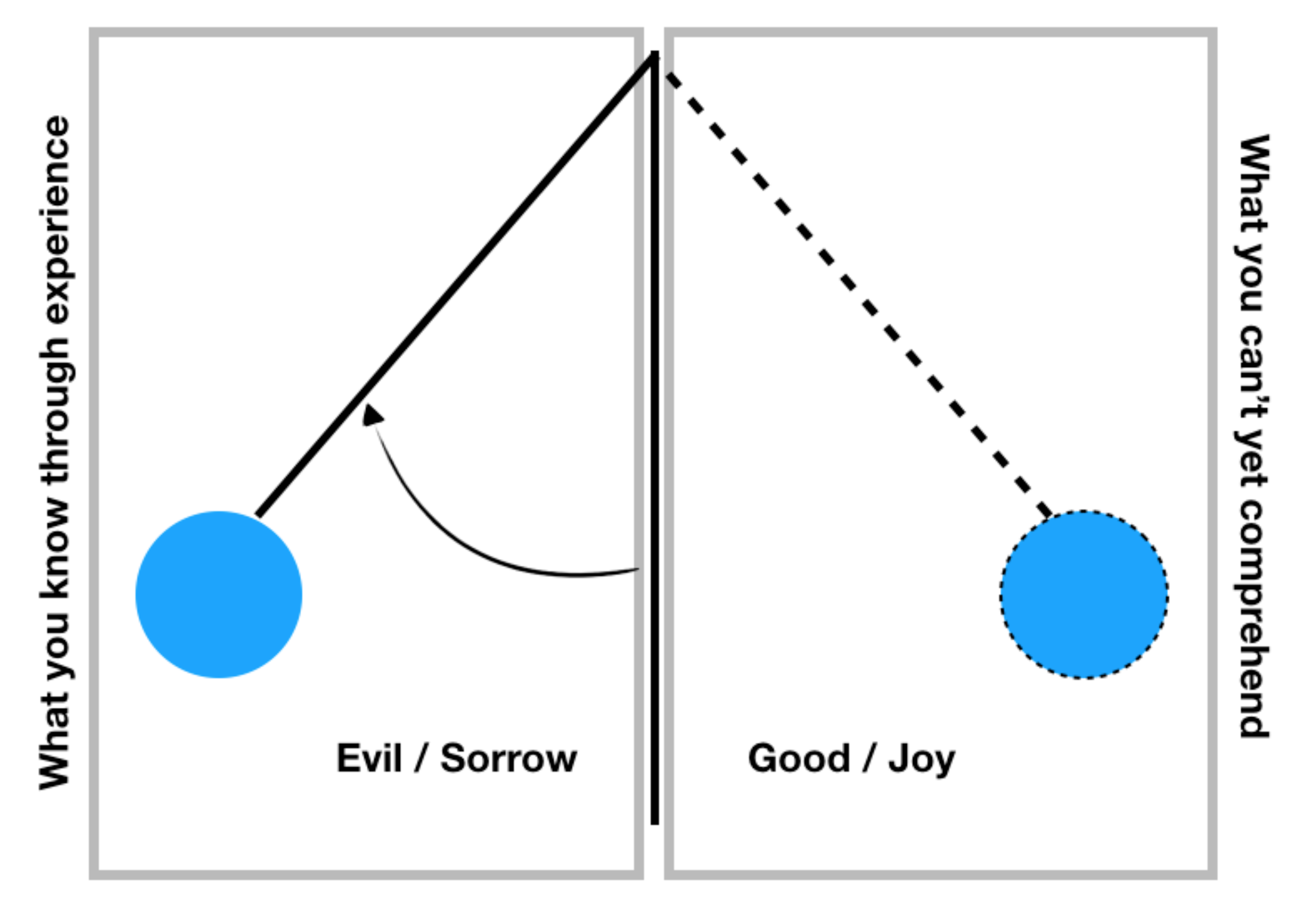
Finding greater joy is like swinging a pendulum. You increase in joy by first being willing to suffer. This willingness to suffer doesn’t require you to invent ways to suffer. Rather, it is your subjection to the unending process of self-scrutiny and learning. You will gain a greater awareness of what is evil in this world—including in yourself—and you will have opportunities to fight against it: by changing how you are and by acting in spite of the way the world is.
The absence of sorrow is not joy. The pathway to greater joy always includes greater suffering, at least initially.
Every portion of awareness consists of increased evil and suffering, and only through trusting God can you endure it sufficiently to obtain the equal and opposite good and joy that it also entails.
This is a process. You have to trust in God enough to subject yourself to evil and suffering you do not yet understand; then you can grow to understand it, and reap the joy that comes in equal and opposite proportion. First, you learn the depth of evil by experiencing it. Second, you experience even greater sorrow and pain by becoming aware of the existence of the good and joy commensurate with the evil and sorrow you’ve experienced, without actually experiencing it yet. Third, you finally obtain the joy you are now prepared for, because you have a knowledge of what it is like not to have it, what the opposite is, and you can comprehend and appreciate it.
This process is always the same. It involves a great deal of suffering on our part. However, this suffering is the only way we can, through the justice of God, encounter the great blessings he anxiously awaits to give us. Like releasing the pressure on a pressure cooker before the meal is cooked, if we exit early, all our suffering will be in vain.
There are two ways to minimize pain in life. The first way is to actively try to avoid it. Almost everyone will say that they are interested in finding greater joy, but almost no one will do what brings it when given the chance. Those who are at least willing to entertain the idea, for the most part, are actually just interested in minimizing the pain they are experiencing in life.
Some suffering is truly avoidable and unbeneficial. Avoidable pain and sorrow are caused by living contrary to the path of happiness, which can happen in one of two ways: 1) you do not know the way or 2) you don’t walk in the way even though you’ve been shown it.
Avoidable pain is a signal that there is something more to learn about the situation causing you pain. If you are wise, you will either use that pain to motivate you to search for what you lack or to accrue evidence for more carefully living up to what you know.
We should not pray to have God remove trials from us. Instead, we should reconcile ourselves to God's will and ask him to bless us with the knowledge we need to overcome our trials.
Some sorrow is unavoidable, but beneficial, and seeking to avoid it will only cause you and others more pain.
Unavoidable and beneficial sorrow is typically tied to perceived value. We can only derive joy from what we value. Sometimes, the only way to obtain an actual valuation of something is to experience its opposite.
Realize that everything you unavoidably suffer is a necessary precondition to receive the equal and opposite good that you likewise do not yet know. Before you know great sorrow, you can’t really know great joy. How can you ever be maximally grateful while you remain unaware of just how bad things can be?
You can try to avoid pain by detaching from people and situations, from intentionally diminishing your needs and feelings, or by masking your pain with things that distract you from it. Although each of these tactics might reduce pain caused by a specific thing, they will actually increase the amount of pain you suffer because they will fail to address the underlying problem while causing other additional problems.
God turns up the affliction and temptation knobs as fast as we can handle them. As we increase in favor with God, he allows us to experience more and greater affliction. Consider the patriarchs and other righteous people. Without fail, those who were promised eternal life by God were exposed to miserable hardships. These men and women lived out lonely lives filled with suffering. Yet, Jesus approached near unto them in accordance with their sufferings.
God only withholds trials from those who have demonstrated their inability to deal with them. Instead of rejoicing when times are easy, we ought to take careful stock of our lives.
The second way to minimize pain in life is to learn and grow from it. Learning requires suffering.
The gospel is not the path to avoid suffering. It is the path of maximized joy, not minimized suffering.
There is a popular yet erroneous belief that because of Jesus’ life and death, we don’t have to suffer. The Lord’s sacrifice does not magically remove suffering. Rather, his purpose was to forgive previous sins and provide a path to obtaining and obeying his teachings:
11 And he shall go forth, suffering pains and afflictions and temptations of every kind; and this that the word might be fulfilled which saith he will take upon him the pains and the sicknesses of his people.
12 And he will take upon him death, that he may loose the bands of death which bind his people; and he will take upon him their infirmities, that his bowels may be filled with mercy, according to the flesh, that he may know according to the flesh how to succor his people according to their infirmities.
13 Now the Spirit knoweth all things; nevertheless the Son of God suffereth according to the flesh that he might take upon him the sins of his people, that he might blot out their transgressions according to the power of his deliverance; and now behold, this is the testimony which is in me. (Alma 7)
14 And behold, this is the whole meaning of the law, every whit pointing to that great and last sacrifice; and that great and last sacrifice will be the Son of God, yea, infinite and eternal.
15 And thus he shall bring salvation to all those who shall believe on his name; this being the intent of this last sacrifice, to bring about the bowels of mercy, which overpowereth justice, and bringeth about means unto men that they may have faith unto repentance.
16 And thus mercy can satisfy the demands of justice, and encircles them in the arms of safety, while he that exercises no faith unto repentance is exposed to the whole law of the demands of justice; therefore only unto him that has faith unto repentance is brought about the great and eternal plan of redemption. (Alma 34)
The Lord’s life and death don’t magically remove your suffering. But it does provide a path to avoid the suffering that is due to suboptimal behavior and to make unavoidable suffering worthwhile.
The gospel frees you from the portion of sorrow you bring through your own mistakes by teaching you better ways to live, but the other portion of sorrow—the part caused by other people—actually gets worse the more understanding you have, not better. The gospel does not free you from all sorrow; it makes the sorrow worth it.
We are told that “...men are, that they might have joy” (2 Nephi 2:25), not “men are, that they might avoid pain.” You can't improve your situation without first experiencing the discomfort of recognizing the reality of your situation, and that includes all the ugly parts. Suffering can come from several sources:
- Consequences from acting contrary to joy, truth, or God. Whether you seek it or not, you will be ever-exposed to a greater share of the consequences of your actions. God does this to help you better understand the path to the abundant life.
- Pain from things done to you. This increases the more you serve God because the more you serve him, the more frequently and intensely people will persecute you. Charity for others mitigates this type of suffering.
- The revelation of the unknown. This increases with awareness, but can go away completely through trust in God. Everything he does is for the benefit of the world. All things work for good to those who love God.
- Vicarious suffering through empathy for those who act contrary to joy. Inasmuch as you care about other people, you will experience their pain as if it were your own. This can exceed their present pain to the degree that you comprehend consequences of their action or inaction that they do not. This increases with your growth.
The sources of suffering suggest that, rather than avoiding greater suffering, we ought to embrace learning and all the suffering that must occur to enable it.
Suffering empowers us to experience heightened joy. Sorrowful moments grow our purpose. With a stronger, better purpose, we can withstand more intense sorrow. With a strong enough why, you can endure any what.
You have to actually comprehend the magnitude of good and evil. Whether you choose to or not, you will eventually be exposed to everything, anyway: “we shall have a perfect knowledge of all our guilt, and our uncleanness, and our nakedness.” (2 Nephi 9:14) The choice is not whether it will be revealed, but whether you will seek to learn it now— when there is still benefit in doing so—or later, when you no longer have the opportunity to obtain the tools to have maximal joy in spite of your knowledge:
27 But wo unto him that has the law given, yea, that has all the commandments of God, like unto us, and that transgresseth them, and that wasteth the days of his probation, for awful is his state!
38 And, in fine, wo unto all those who die in their sins; for they shall return to God, and behold his face, and remain in their sins. (2 Nephi 9)
I must work the works of him that sent me, while it is day: the night cometh, when no man can work. (John 9:4)
The better you become, the more evil you become aware of. The more light you have, the more darkness you can perceive: “And the light shineth in darkness; and the darkness comprehended it not.” (John 1:5)
Maximal joy is perhaps the rarest thing in life. One reason for this is that it is encountered in the deepest sorrow. Don’t fear the revelation of greater sorrow. The only way to approach maximal joy is through great suffering.
The joy you find in life will be determined by how much sorrow you are willing to walk through first. When you place a limit on how much you are willing to suffer, you will always limit how much joy you can receive. You have to suffer everything there is to suffer before you can experience all available joy. If we want to have more joy, we ought to expect things to get worse and worse.
Some people possess tools that are adequate to contend with the degree of sorrow they are aware of. This doesn’t mean there doesn’t exist sorrow beyond the strength of their current tools. In order to contend with all of the negative things possible in life, you need all of the tools that are available in this life. You can’t overcome what you have not yet experienced. You must descend below all things in order to ascend above all things.
The joy/sorrow cycle
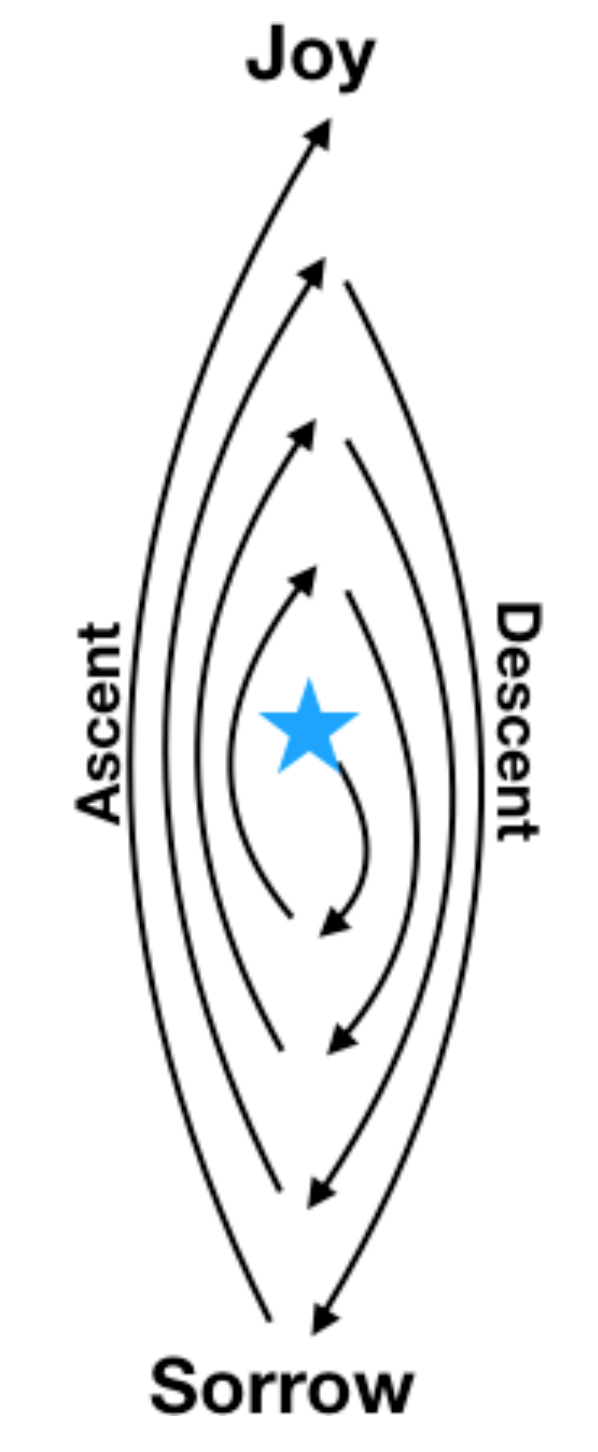
If a child has the fortune to be born into a stable family, they will grow into a young adult largely insulated from the chaos of life. Part of adulthood is coming into unchaperoned life.
Adults do not have walls to protect them from the occasional but often intense exposures to what this world is capable of doing. When a person is hit with the first main crisis of their lives, they undergo a descent into degrees of sorrow of which they were perhaps not previously aware. Some never come out of it, and others escape it through the same seemingly random events that got them there. Some few actually gain an awareness of what they previously lacked, obtaining the tools required to overcome the thing that initially overcame them. These people end the experience having ascended to greater joy than they had prior to the decent into greater sorrow.
Descent can consist of many different things. Typically, it includes the revelation of a greater degree of reality beyond your previous awareness.
If you want something better than what you have, the only way to get it is for the Lord to show you that what you have isn’t as good as you thought—either by exposing you to something better or by showing you something worse about what you thought was good.
You are free to embrace what you have been shown and actively seek to incorporate what you have learned into your life, or you can attempt to flee from it.
Fleeing from increased awareness may free you from thinking about reality, but it will also free you from any chance you have of improving your outcome. Also, turning from increased understanding won’t free you from the consequences of your understanding. Falling doesn’t hurt less if you don’t realize you are falling, but realizing you are falling may give you an opportunity to stop before you hit the ground.
To maximize the amount of joy you obtain in this life, it is necessary not only to recognize the pattern of descent and ascent, but to realize that it is a cycle, and you can make as many rounds upward as you choose to.
The Lord taught that while some descent arcs come whether we seek them or not (see Matthew 5:45), we can opt to participate in more by choosing to be teachable: “For whosoever exalteth himself shall be abased; and he that humbleth himself shall be exalted.” (Luke 14:11) Teachability is a factor of how honest we are about life, others, and ourselves, as well as a realistic view of how little we know.
Did Jesus experience descent? Of course he did. He had to live through the successive revelation of the impermanence and limitations of everything he valued in life, until all that was left was the goodness of the Father. Meanwhile, what he understood of the goodness of the Father increased line upon line.
Descent cycles help us improve. Pause for a moment and consider the last time you were in a great deal of pain. The pain need not be physical— emotional pain is at least as effective. How close were you to God before the onset of that pain? And during? How willing were you to find something better before? During?
While we are in a descent arc, it is much easier to seek and apply what is needed to improve. We are more willing to ask: What am I lacking that this shows me? What am I going to do about it? What is the principle that conquers this, either in removing the effect of some previously unseen cause, or in providing me understanding to allow me to experience joy in spite of this pain, or in helping me appreciate what I previously took for granted?
It is possible to be just as pliable in an ascent arc. There are those who can cry out to God with just as much earnestness outside of suffering as in it, but for most of us, this is beyond our current capability.
Suffering shows you the limit of your trust in God. Even Jesus learned obedience by the things he suffered: “Though he were a Son, yet learned he obedience by the things which he suffered;” (Hebrews 5:8)
Suffering provides you the opportunity to acquire the next level of trust in God.
The true vine
The Lord said:
1 I Am the true vine, and my Father is the husbandman.
2 Every branch in me that beareth not fruit he taketh away: and every branch that beareth fruit, he purgeth it, that it may bring forth more fruit.
3 Now ye are clean through the word which I have spoken unto you.
4 Abide in me, and I in you. As the branch cannot bear fruit of itself, except it abide in the vine; no more can ye, except ye abide in me.
5 I am the vine, ye are the branches: He that abideth in me, and I in him, the same bringeth forth much fruit: for without me ye can do nothing.
6 If a man abide not in me, he is cast forth as a branch, and is withered; and men gather them, and cast them into the fire, and they are burned. (John 15)
Branches are living. They are connected, through other people or directly, to the true vine, Jesus Christ. His light and truth flows through them.
To be clean is to be reconciled to the truth you have received already, or to be living up to everything your conscience tells you.
He will teach you more, improving the capacity of your conscience by increasing what you understand and changing the way you see things. The more branches you grow, the more knowledge you have, the more fruits you have the capacity to bear.
There is a difference between branches and fruit. There are things in your life right now that you see as branches that are actually fruits, and there are things in your life that you see as fruits that are actually branches.
Fruits are terminal. They appear at the end of branches. They are not connected to anything else. They grow from blossoms to buds to fruit, ripen, then are enjoyed and perish or rot and perish, but either way they perish.
Fruits only grow on young branches. Choosing to stop growing means choosing to end your fruiting. You can stop with one little stub of a branch, or you can grow into a massive cluster of fruiting branches.
Fruit can be very enjoyable when it is ripe, but it will always, in the end, be "purged," or taken away. It is in the sustaining of the branch, and not the preservation of the fruit, that fruit will continue to be available. It won’t be the same fruit, but it will be more fruit. It is taken away by increased awareness that shows it isn't what you thought, that it changed, or that there is something much better.