In order to convince you to keep reading, I need to tell you up front how the ideas presented in this book will change your life for the better. The good news is that because these ideas will more directly cause greater improvement in your life than anything else of which I am aware, that’s really easy to do. The bad news is that they are so beneficial that I don’t think you’ll believe me. As you continue to read, you’ll see ample evidence of just how powerful these ideas are, how immediately they can be put into practice, and how quickly they will transform your life for the better. For now, let’s begin with a story.
A life of unparalleled purposeful productivity
Throughout my life, I have outperformed those around me in most ways. I’ve had an unusual number of jobs and other activities, and the resounding consensus from my peers and supervisors has always been than I am the most productive person they’ve ever met, though the form of expression has varied, from “I don’t understand how you finished this already” to “how do you get so much done” to “knock it off—you are making us all look bad.”
That said, you might assume I’ve had some sort of challenge-free life or that I am particularly gifted. Though the space to prove it would take a biography, I promise you that both of these couldn’t be farther from the truth. As a child, I routinely felt as if I had to work much harder, longer, and smarter at things to perform at the same level as my peers. The lack of stability from moving eighteen times before I was eighteen years old meant that I was always catching up on something— and often many things—in some aspect of my life. The beauty of an early disadvantage is that if responded to with tenacity, it can motivate the establishment of a pattern of exerting extreme force into what one sets out to do in spite of great obstacles, acting like a giant flywheel, building momentum with each activity that carries into the next throughout one’s life. Somehow in the chaos of my childhood, the tenacity of tearfully learning how to write, tell time, learn basic math, and grow in fitness that seemed to come so easily to other kids transitioned into greater and greater momentum to continue applying outsized effort even after I caught up.
Time and again, I found myself promoted—to gifted and talented classes in school, to supervisory positions at work, to higher ranks in the military, and so on.
Consider the following examples in the domain of employment. I began working for my grandfather’s construction business picking up trash at eight years old for a brief stint over the summer. By the time I was 15, I was made supervisor of a man in his sixties on a construction crew. During the school year, I was working as a cart attendant at a grocery store, and quickly promoted to a shelf-stocker. Then I took a job as a restaurant cook, where I was training new hires within the first week as a restaurant cook. At 17, I was hired for an internship at an insurance company. Within two weeks, I finished the work my predecessor had accumulated over a year as an intern, and had to find another job because they had run out of more work to give me. I found a job at a computer store where my assignment was to clear an overflowing stockroom full of broken computers that needed to be walked through the long process to gain authorization for return to the the vendor. I had the room completely cleared in a matter of weeks, much to the shock of the owners, who promoted me to fixing computers because they had nothing else for me to do in my prior position.
This pattern continued through my undergraduate years and into the first jobs following. My assignment in my first programming job was to single-handedly build a piece of software that would not only replace but improve upon an established product built by a large company. In six months, my completed project was in production earning the hospital millions in new revenue per year. Within two job changes in three years, I found myself leading a small software company, where I had been promoted over the engineer that had hired me after successfully replacing the failed code produced by two engineers over two years in just two months after starting.
I returned to university where I completed MS and Ph.D. degrees in computer science within six years, graduating with more peerreviewed publications than anyone in our large, competitive graduate program all while having four children in diapers, fully remodeling a derelict starter home, writing two books, and serving as a company commander in the National Guard. At 30, I became the youngest hire on the computer science faculty I joined, in spite of delays in my timeline caused by several years of full-time work in industry, two years of missionary work in Chile, and ten years in the National Guard. I was promoted to Assistant Professor one year early, earning competitive rewards for research and receiving excellent reviews for teaching. I was awarded tenure, having outperformed my previously tenured peers in grants awarded and papers published in spite of founding and running a tech company, building a hobby farm, and writing another six books during that time, in addition to being a husband and father to five small children.
This is not a complete story, but it should help you believe that I know a thing or two about productivity. I have only been able to do what I have because I live the system I am going to show you in this book. It works, and my life is abundant proof of it.
The story of what I accomplished does not describe the challenges I worked against, which were much greater than I can take the space to describe. How did I do so much in so little time? How did I overcome what would overwhelm most people with stress, anxiety, and depression? How did I deal with the uncertainty and the sheer amount to do? Where did I find the motivation to continue through so many long projects? And why did I consider it all worth the cost? In this book, you’ll find the answers to all of these questions, but first we need to stop talking about me, and start talking about you.
What do you want the most, and why do you want it?
One day, while walking along, you find an old Arabian lamp. It’s scuffed and dented, but you figure you don’t have much to lose by rubbing it, so you give it a shot. Out comes a shabby genie who explains that while he can grant wishes, that as the discount version of the legend we all know, he can only give you one. What would you ask for?
After you tell the discount genie your wish, he gets into the fine print. He explains that he doesn’t have the kind of budget those deluxe genies have. They can afford to give everyone whatever they ask for, but only if they limit their requests to what they really want. It turns out that different things are worth differing amounts to different people, and very few people really want what they say they want. In order for him to grant your wish, you have to convince him that you want what you are asking for enough to justify its cost. Do you think you could convince him?
In reality, outcomes of tremendous value are available in life, and all of them have a certain price. While the budget genie is not real, the opportunity to have what you are willing to pay for is.
You can have anything you are willing to pay the price for. Part of that price is finding out what it takes to obtain it; the other is doing just that.
When you explicitly define what you want and how you expect to receive it, your achievements will reach further toward your potential than ever before. You will more consistently do what is needed on a daily basis to bring about the outcomes you say you desire.
In order to obtain what you want in life, you’ll have to learn how to do so and and be willing to do what is necessary to get it. Part of what is necessary will be to prioritize what you want among competing options, because your resources are limited and the things of greatest worth tend to demand a great many of them. You can’t prioritize what is of greatest worth if you do not yet know what you want.
You can’t intentionally choose what you do if you don’t know what you want
In Lewis Caroll’s book, Alice asks the Cheshire Cat for directions and gets a philosophical exchange that is more than the directions she was looking for:
“Would you tell me, please, which way I ought to go from here?”
“That depends a good deal on where you want to get to,” said the Cat.
“I don’t much care where–” said Alice.
“Then it doesn’t matter which way you go,” said the Cat. “–so long as I get SOMEWHERE,” Alice added as an explanation.
“Oh, you’re sure to do that,” said the Cat, “if you only walk long enough.”
While the Alice in Wonderland books were written a very long time ago, the same principle of guiding purpose applies in the countless examples of modern autonomous robots that surround us. A robot cannot decide where to go unless its programming tells it what is most important. It will have a certain set of possible actions defined, and it will be told to use them in order to maximize some outcome, usually subject to certain constraints. For example, an autonomous car might be told to go from point A to point B in the minimal time while obeying traffic laws and not colliding with any other objects or people. If the robot did not have its purpose, potential actions, and constraints defined, it would not be able to navigate in any but random moves, causing random outcomes instead of arriving at the intended destination.
Most people live life full of situations they don’t particularly want that they obtained through walking long enough in directions they didn’t particularly think through. Most people never arrive at their intended destination, and many encounter infractions and collisions along the way that they would have rather avoided. The reason is simple: humans don’t tend to approach life intentionally.
What do you want? Joy.
If we were sitting face-to-face, we could go through the following exercise: I would ask you what you want more than anything else. You would answer. I would ask you why you want that. You would answer. I would ask you why again. You would answer. If we continued this exercise for long enough (it usually only takes three or so rounds), we would arrive at what you really want, and it would almost surely be different than what you said you wanted at first. It wouldn’t be the sports car or pony or even the college degree for your child that you said you wanted at first—it would be joy. Joy is what you really want, and you only say you want everything else because you believe those other things will give you more joy than anything else.
The things people say they want when first asked are surrogate sources of joy. They are useful intermediaries that serve as waypoints on the path to greater joy, but they are not joy itself. While they are essential to guiding you closer to what you seek, their utility is limited, and you will never reach what you seek until you understand those limits.
Seeking joy through a surrogate goal can never lead you to levels of joy greater than what that surrogate goal can provide. In order to overcome this limitation, surrogate goals must be considered in conjunction with other known alternatives, as well as the understanding that something presently unknown will always lead to still greater joy than the best thing you presently know. Intermediate sources of joy will always reach a point where they fail to justify the existence of evermore suffering in life.
Joy is the purpose of life
The purpose of life is to gain joy. At its root, everything we do is to maximize joy. It is inescapable. Joy is the sensation of value. Value is, by definition, what we want. We seek what we want, which is what we value. Thus, we seek to maximize joy. All human choice is to that end.
That the purpose of life is to gain joy isn’t a new idea, even if it was never explained very well. Anciently, Aristotle said: “Happiness1 is the meaning and the purpose of life, the whole aim and end of human existence.”
With sufficient joy, anything in life can be worthwhile. Without sufficient joy, nothing in life is worthwhile. Joy is the greatest potential benefit, and with enough of it, any cost can be worthwhile. In fact, fundamentally, all benefit is either joy or something expected to lead to it, and we value it in accordance with how much joy we expect to receive through it.
To fulfill your purpose in life, you need to maximize the joy you encounter. You will never do this unless you intentionally seek to do so.
Intentionality is living according to a chosen purpose
Intentionality is a way of living so as to maximally pursue a chosen purpose, subject to explicitly defined options and constraints. Intentional people have a why for every what, a what for every why, and all are explicitly prioritized towards a transcendental goal.
Unfortunately, instead of thinking conscientiously about what they really want, why they really want it, and how to get it, most people live their lives as if what they receive has nothing to do with what they feel, think, or do.
Most people lumber through life only partially aware of any degree of detail and almost no intention. It is no surprise, then, that after years of a lot less joy than could be had, they suddenly find themselves in a situation they never wanted. This is as true on the micro scale as it is on the macro scale. Countless people are daily confronted with shocking, painful situations they never expected, where they are astonished by the sudden loss of some or all of what they thought was real, good, and enduring.
Drifting along through life is not a strategy for success. In order to live life well, you must live life intentionally. If you want to drive a sailboat to a predetermined destination, you have to learn all about how that ship works: you need to understand the rudder, the sails, the food stores, and everything else on the ship that connects to its ability to drive you to your destination. So it goes with your self awareness. You have to understand why you do what you do.
Perhaps the most important aspect of intentional living is self discovery. If you want to obtain the greatest outcomes, the only way to do so is to learn how to intentionally search for and obtain them.
Intentionality is the secret to my success: I accomplished such a litany of achievements in such a brief time against great opposition because I chose a purpose that was worth it, and I aligned my entire life to it. That purpose was joy. In this book, I am going to show you how to do the same. If you follow the system I show you, you will be amazed at how effective it is and how bountifully your efforts are rewarded.
Human inconsistency on full display in inconsistently intentional living
We live in a world full of the necessity and fruits of general intentionality. The sophisticated products we use daily could never be designed, manufactured, or even distributed without intentionality, and even the stories engraved in our cultural memory—from Alice’s Adventures in Wonderland to The Matrix— prominently feature its necessity and the consequences of being without it.
How is it that so few people live intentionally with any intensity or consistency?
What keeps people from being intentional?
Being intentional is not merely a question of understanding the reasons or making the decision to be intentional, though these are adequate barriers and will be amply addressed in this book. Intentionality not only requires you to know your purpose, it also requires a way to map that purpose to and through every domain and moment of life. The extent to which you can understand and apply your purpose in every facet of life is the extent to which you achieve intentionality in life.
The primary obstacle to intentionality is the lack of a pragmatic framework that effectively maps your purpose through your life, across all aspects of life, and in scopes of time: from how you operate internally, to how you interact with the world from the big to the little, and from each moment to the full span of your remaining time on earth.
Without such a framework, it is highly unlikely that you will:
- Find and adopt a purpose that you feel is important enough to subordinate everything else in your life to.
- Understand and leverage character improvement for increasing resilience and developing deeper meaning as you pursue your purpose.
- Discover how to unlock unimaginable productivity by organizing your life into audacious, coordinated goals that advance your purpose.
- Free yourself from the prisons of depression, anxiety, and procrastination through subduing emotions to reasoned, intentionally optimized living.
- Fluidly and intelligently adapt to the constant learning opportunities and fluctuations provided by reality.
A sufficient framework for intentionality will provide these and many other benefits that will so extensively improve your life that you will have to experience them to believe it.
What is the opposite of intentional? Being pathological
The word pathological was coined to describe poor human choices with the same nomenclature as disease. If a pathogen is in your body, your body can fight it using various internal systems designed for that purpose.
In modern times, pathological conditions are treated as if they were untreatable diseases. Excusatory language attempts to absolve individuals from any personal responsibility over how they think, feel, and act, but no amount of excusatory language will absolve them of the guilt they feel over poor choices they make, nor spare them from the real world consequences of doing so.
Pathological thoughts, actions, and feelings are not conditions beyond the control of the individual. Instead, a pathological state is one in which a person ceases to be intentional.2 They become passively emotional instead of proactively rational.
When people fail to live intentionally, they allow emotions, other people, and situations dictate to them what is important. This causes their prime purpose to unconsciously and constantly change, becoming an equally unconscious source to wasted energy, poor outcomes, and a host of undesirable feelings along the way. The cure to all of these problems is to intentionally seek greater joy.
Intentionally seeking joy
Joy is a feeling, but the label doesn’t stipulate its source, duration, resilience, or intensity. The source of joy is incremental progress towards worthwhile goals. The amount of joy you encounter in life will be determined by how effectively you pursue the greatest possible improvement, and what you gauge as improvement will depend on many things, including how you see yourself, others, and the world. While the purpose of all people is to obtain greater joy, the details of how they will achieve this are as varied from one person to another as their fingerprints.
Factors that will increase the amount of joy you experience include how effectively you find and pursue what is best, how thoroughly you define and become the ideal person, and how consistently you do all you can toward these ends.
Breaking an overarching purpose down effectively into daily actions is no easy task. This is exactly why the framework described in this book is needed, and the purpose it serves. The purpose of a life plan is so that you make decisions differently on a daily basis. It is a tool that will help you act more effectively in large and small ways to more effectively accomplish your desires.
Though the details between people will differ, all will find that greater joy is found as you intentionally seek it. In this path, you will find more meaning daily as you consistently act in ways that orient you toward the greatest improvement.
There are vast differences in quantity and duration of joy experienced between people
Humans incline towards the same fundamental desires. If we all share joy as our fundamental desire, why is it that we differ so much in our specific desires, and even more in what we believe and in how we act?
The difference in how different individuals approach the search for joy—or if they do at all—generates significant differences in the amounts of joy they encounter. While we may share the same fundamental desire, we do not share the same external circumstances or internal qualities. We differ in our beliefs and how thoroughly we edit and live them, our experiences and their interpretations, and the direction and intensity of our efforts.
Joy can come from different sources, and the source you choose to recognize is part of the reason for the wildly different ranges of intensity of joy experienced between and within people. Joy can come through bodily sensation or mental meaning, and they are not equal. Joy that comes from bodily sensation occupies a range of intensities, but is drastically limited compared to the upper bounds of joy that comes from meaning. Joy through meaning comes from the alignment of your actions and your chosen purpose.
The intensity of joy you experience will also depend on the value of the meaning you’ve chosen and the degree to which you have sacrificed to that meaning.
The value of the meaning you’ve chosen is a composite of the actual value of the meaning and the value you perceive. You will experience the lesser of the two, meaning you can’t enduringly experience greater value than something actually has, and you can’t experience greater value than the limits of your perception of its actual value.
Your ability to maximize joy will depend on your discovery and choice of what has the greatest value. This is why it is so vital to understand as much of reality as accurately as possible. You have to comprehend what was, what is, and what will be. Only then can you fully view the range of options before you and the value of each.
It’s important to realize that the options of greatest value will carry the greatest price. The price of things of great value act as a gate controlling who has access to them: those who do not understand the value of great things will never pay the price required to obtain them.
Can we quantify the amount of joy it is possible to experience relative to the amount of joy experienced by the average person?
Most people are terribly unhappy. There is plenty of data and anecdotal evidence to support this. It should be plain that the average person is miserable. They are lonely, overweight, broke, stressed, sick, depressed, anxious, and apathetic.
How much joy is it possible to have, and how many people encounter more than average? Perhaps it seems that it is impossible to say, since joy is not as externally measurable as something like wealth.
The key is to understand that joy is one of many Pareto-distributed attributes.
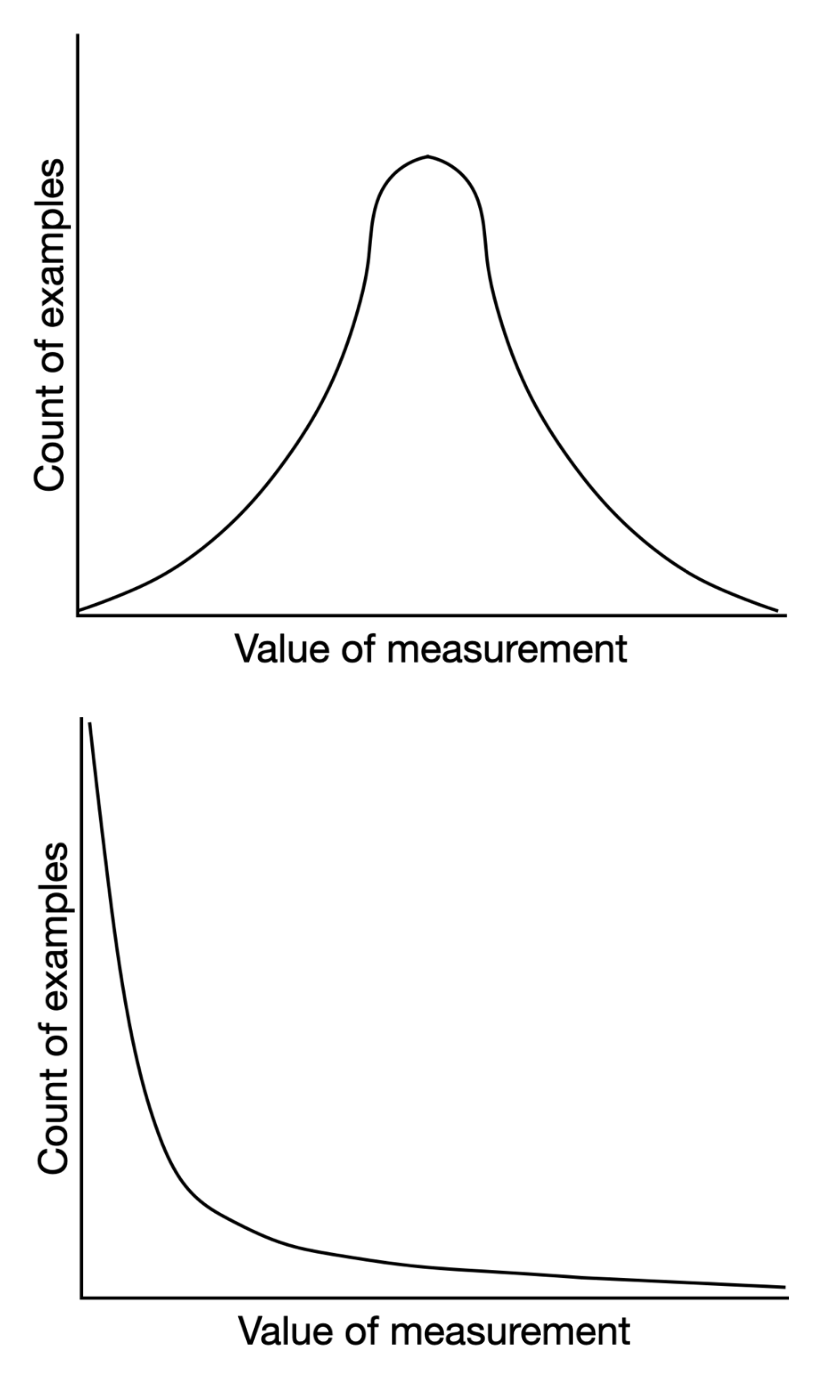
The measurement of the range and count of a property across a population is called a distribution. While uncountable properties exist across reality, they tend to recur according to only a few patterns. By naming and recognizing these patterns, we are able to instantly ascertain a great deal of information about what would otherwise be a poorly understood situation.3 Distributions can be graphed using a curve that increases or falls based on the count of people with increasing amounts of whatever is being measured as you go from left to right.
The Pareto distribution has most of the area under the curve over by the low end of whatever is being measured, and the curve drops speedily to near zero shortly thereafter. Most people have heard of this distribution, whether by name or property, but everyone has seen it in action. Sometimes it is described as the 80/20 rule, and examples are found in many cases in nature and human behavior. For example, most earthquakes are of low magnitude, most traffic occurs on very few of the total set of roads, a small set of the salespeople make most of the sales, 80% of car accidents are caused by 20% of people, 80% of time spent watching movies comes from 20% of movies, and most famously, 80% of wealth is held by 20% of people.
Research will show that every outcome determined by human choice based on perceived value results in a Pareto distribution of results. With this in mind, though we can’t directly measure the distribution of human joy, we can accurately predict it. It will follow the same distribution as human wealth. This isn’t to say that those who are poor in money will be poor in joy and vice versa, but that we should expect that the magnitudes and spread of joy among humans will be similar to how money is distributed among people.
What does the wealth distribution look like in magnitude and spread? In 2020, Elon Musk was 1.5 million times more wealthy than the average middle class American4 and 378 million times wealthier than most Americans, who are poorer than that.5
If joy is Pareto distributed, it can provide us a clue as to how much joy it is possible to have. If joy is Pareto distributed, 80% of the joy is experienced by 20% of the people, while most people have hardly any joy at all.
The proposed extremity of the limits of joy may seem exaggerative, but it is no harder to believe than the extremities of wealth. If wealth and joy are distributed according to the same pattern, it is possible to be many thousands of times more joyous than the average person and that the “most joyous” person may be millions of times more joyous than the average person! It is not unreasonable to suppose that the most joyous person is as joyous as the summed joy of many other people, just as Musk had as much money in 2020 as the sum of 378 million average Americans. Just think about that.
The greatest joy requires full alignment of your actions, beliefs, and desires with what is actually most valuable
Lasting happiness comes from your understanding of what has the greatest value, how it is obtained, and the degree to which your actions reconcile to it. It comes from your ideas about how life works, how well those ideas align with reality, and how well your actions and desires reconcile with those ideas.
Your ideas about how life works are your beliefs. Beliefs differ between people and even in the same person over time and circumstance:
- Not all beliefs can produce the same degree of happiness.
- Not all beliefs are equally correct.
- Not all beliefs describe equal amounts of reality.
- Not all beliefs produce the same depth of meaning.
What you value, what you believe, and what you do will dictate how fully you are able to improve in life. Each of these three aspects of your choices will affect the others, and any friction between them caused by conflicts will impede your ability to improve, and therefore your joy. Joy flows at its greatest when what you believe, what you desire, and what you do are aligned.
Before joy can flow, action must be oriented towards its source. Joy comes from value. Maximal joy requires you to identify, find the path to, and do what is necessary to obtain what has the greatest value.
Before your joy can be full, your actions must be fully aligned with your desire and beliefs, and your desire and beliefs must be oriented to what is actually most valuable. How will you find it?
Robots find their way by learning as they go; so can you
There are seemingly good reasons not to bother with living intentionally, all revolving around uncertainty. Admittedly, no one knows everything there is to know about every potentiality in life. In every choice we face lies the possibility that there was something significant we missed or that a better choice existed, even when we do all we can to analyze the choice before making it. Any serious advocate for intentionality must make a case as to why doing the best you know equates to doing the best there is. The best argument relies on belief in a just, all-knowing God who will orient you to the best eventual outcomes here and hereafter, through incremental increases in understanding, as you do the best you know. However, a sufficient argument can be made simply by appealing to how robots handle this problem.
Robot pathfinding algorithms create interesting patterns that grow like slow-motion forks of lightning, with the robot fluttering between potential paths while incrementally investigating the very next segment of the most attractive path so far. If the additional information provided by the present exploration causes the present path to become less attractive compared to an alternative fork, the robot will go and continue exploring the other path.6
There is an optimal path that maximizes your purpose, and the way you will find it is through incrementally adapting your strategy as you learn and grow.
The complexity of the modern world presents a novel challenge
Unintentional living has never produced the abundant life, but living passively today is much more likely to lead to a harder life than in times past.
The modern world is more complex than anything humans have ever seen. Human history until now has consisted of tasks that were:
- Immediate. Much of historic human action provided instant feedback. In the present day, it is not unheard of to need to wait years before the efficacy of choices becomes evident.
- Obvious. Many historic tasks featured predictable pairings of cause and effect, with readily-recognizable markers of progress and early indications of successful solutions. The modern world is full of problems that are sufficiently arcane that large numbers of people attempt each available option, many of which lead to catastrophic results. Meanwhile, many poor choices have strong short-term positive incentives, and many poor choices come with little accountability.
- Focused. Historic life featured very few streams of largely consistent information. A normal environment today consists of constant interruptions from multiple streams of everchanging information.
Modern times feature an explosion of the incidence and extremity of stress, anxiety, fear, and insecurity. Some have argued that these conditions demonstrate that our default ways of thinking and feeling are much better suited to the historic ways than the present ways. Whatever the cause, the cure is finding ways to effectively arrange an intentional path through the increasingly numerous and unclear options for action.
Modern life demands more sacrifice, but provides less meaning
Ironically, the complexity of modern living demands greater inputs while providing lesser meaning than historic life. Less than a hundred years ago, establishing a content middle-class family was a much more attainable goal for many more people in far less time and effort than required today. People felt more meaning in life, and it cost them less to find and maintain. Today, the cost of living—in the most holistic sense of the phrase, including the financial cost and the emotional, mental costs—is so much higher than before, and yet it seems that there is much less meaning available in most of the options before us.
Meaning has always been the motivator for hard things. The pairing works well enough when the rewards are sufficient to match the costs. Some problems have always required sustained sacrifice under uncertainty, but they provided rewards deemed worth it.7
Today, many modern problems expand beyond yourself and across others, and the time scales and resources required are exponentially more than in the past. For example, most tech startups today require at least two million dollars and five years just to know whether a minimal viable product is possible or not, and those quantities continue to rise geometrically. Imagine pouring your heart, soul, and life savings into an idea for five years without having any signal to indicate probable success.
Inescapable uncertainty against increased duration and degree of sacrifice has always been a hallmark of some endeavors, like starting new exploratory businesses, but it is spreading to more areas in modern life—areas that do not provide the same kind of rewards as high risk endeavors.
We are naturally incapable of productively managing modern complexity. People are just as inadequate at complex productivity as they ever were, but today’s highly complex world makes those inadequacies more apparent. More and more historically normal situations now require the same level of uncertainty and sacrifice as only a few elite endeavors used to, from normal jobs to normal family relationships. Many of the best outcomes today require long periods without the intermittent micro-rewards that so many people required to remain motivated historically. The demands of the modern world overcome the many weak spots in a person’s natural ability to be rationally intentional and effective.
You need new levels of motivation and meaning to justify the unprecedented challenges that you will face today. To have the confidence to engage in what were historically normal activities in life, and to have any chance at success, you have to have excruciatingly rare resilience and exceptional productivity. You need the wisdom to know what is worth the full investment increasingly required for success in more and more aspects of what used to be normal life. You need the discipline to continue on a task that will take much longer than comparable challenges used to.
The framework described in this book arms you with each of these vital abilities. It maximizes meaning against modern challenges through purpose-driven productivity.
The power of better choices mapped down to the daily level overcomes human nature’s tendency to choose contrary to joy
Most people are capable of weighing the respective value of options in the big picture. Where they struggle is in translating these valuations into the daily scope of life. It’s as if we have different equipment to make big picture decisions than we do the daily ones. For example, one might clearly prefer the welfare of their child to their own, but they might make regular choices day by day that contradict that ordering.
By default, our daily actions will tend to focus on the most obvious short-term benefit. What requires a longer or more intense sacrifice will always be out of bounds to those who never develop a way to sufficiently prioritize what yields greater long-term benefit. Often it’s because it typically isn’t the most obvious, fastest, or most pleasurable thing we could be doing.
By default, humans attempt to maximize present pleasure and this is the opposite of what maximizes joy. The path to maximized joy requires the adoption of thoughts, feelings, and actions that tend to be quite different than what people will choose by default.
The daily choices that maximize joy run contrary to human nature:
- By nature, people prefer short-term benefit. Joy is maximized by choosing what provides the greatest benefit over the longest time, and this tends to be opposite to what provides the greatest immediate pleasure.
- By nature, people prefer what is easy. Joy is maximized by choosing what is best, which will always carry a high cost.
- By nature, people prefer what looks good right now. Joy is maximized by choosing what has the most enduring value, and this tends to be anything but obvious. Long-term value can only be learned through wisdom and experience, neither of which are common or easy to obtain.
- By nature, people prefer choices that reduce their awareness of needs. Joy is maximized by increasing value, and this typically increases the sense of needs by creating new, previously ignorable problems rather than assisting in hiding those already known.
- By nature, people attempt to minimize suffering. Joy is maximized by finding greater meaning, even if it requires dramatic increases in suffering.
In choosing to counter human nature, you may feel you are engaging in some pious sacrifice. The truth is, you are just rationally seeking what is obviously best for you. You aren’t giving up anything. In fact, you are maximizing everything of worth. As amazing as it may sound, in all of these things, optimizing the latter in the short-term always maximizes the former in the long-term.
The power of greater meaning mapped down to the daily level overcomes the challenges of each day
It’s easy to get excited about big, valuable things, but exciting dreams take time to accomplish. The longer or harder the road, the more difficult it is to propagate the excitement for the whole down to the present task at hand along the way.
As you implement a life plan, the meaning you find will cause you to grow stronger and stronger in overcoming any obstacles between you and the outcomes you say you desire that appear along the way.
Each day is the only window we have to work towards or away from joy. Our ability to encounter greater joy in life is completely coupled to our ability to effectively map the big picture down to our daily tasks. In our modern world of ever-increasing complexity, doing so is harder than ever.
Joy comes from meaningful progress on worthwhile goals. Very few goals can be accomplished in a single day. Joy is not obtained by seeking it directly, but by effectively breaking it down into subordinate qualities and goals, eventually culminating in prioritized daily tasks. What is needed is a practical, effective, and easy way to map our overarching purpose through goals down to the tasks we accomplish each day. This mapping is exactly what is provided by the system presented in this book.
Footnotes
- 1. While some would argue that happiness and joy are different phenomena, this book treats them as synonymous. ↩
- 2. “Between stimulus and response there is a space. In that space is our power to choose our response. In our response lies our growth and our freedom.” - Vicktor Frankl ↩
- 3. Most people are familiar with the Normal distribution, or Bell curve. It is a rounded triangle shape, meaning for whatever property discussed, almost all examples are similar and appear close to the center of the graph, where the height is highest. The more different an example is from the average, the less likely it is, giving the distinctive drop-off as the line flows away from the center. Human height is Normal distributed. Most men or women are the same height, and very short or very tall people are nearly equally rare. ↩
- 4. Calculated from the set of people with home equity and at least some investments. According to Forbes, in January of 2022 Musk’s fortune stood at $263 billion. ↩
- 5. As of 2022, 58% Americans have less than $5,000 in savings. ↩
- 6. The keen observer will note that, unlike autonomous robots, human decisions almost always feature high costs for additional attempts. Life is short, many decisions can only be made once, many of the most important decisions must be made early, and many decisions offer choices with catastrophic consequences. For all such problems, you’ll find the only adequate solution is the existence of a just, all-knowing God who will orient you to the best eventual outcomes here and hereafter through incremental increases in understanding as you do the best you know. ↩
- 7. A fairly simple version of this is sales. In sales, unpredictable small actions lead to the majority of your measured results. You have to continuously face apparent failure while working as hard as normal people only would when continuously receiving short-term rewards that exceed the cost. Other examples include art, writing, and other creative work. All of these feature high rates of failure, but outsized rewards for success, and the ratios match up enough that there have always been roughly enough people to meet demand. ↩